
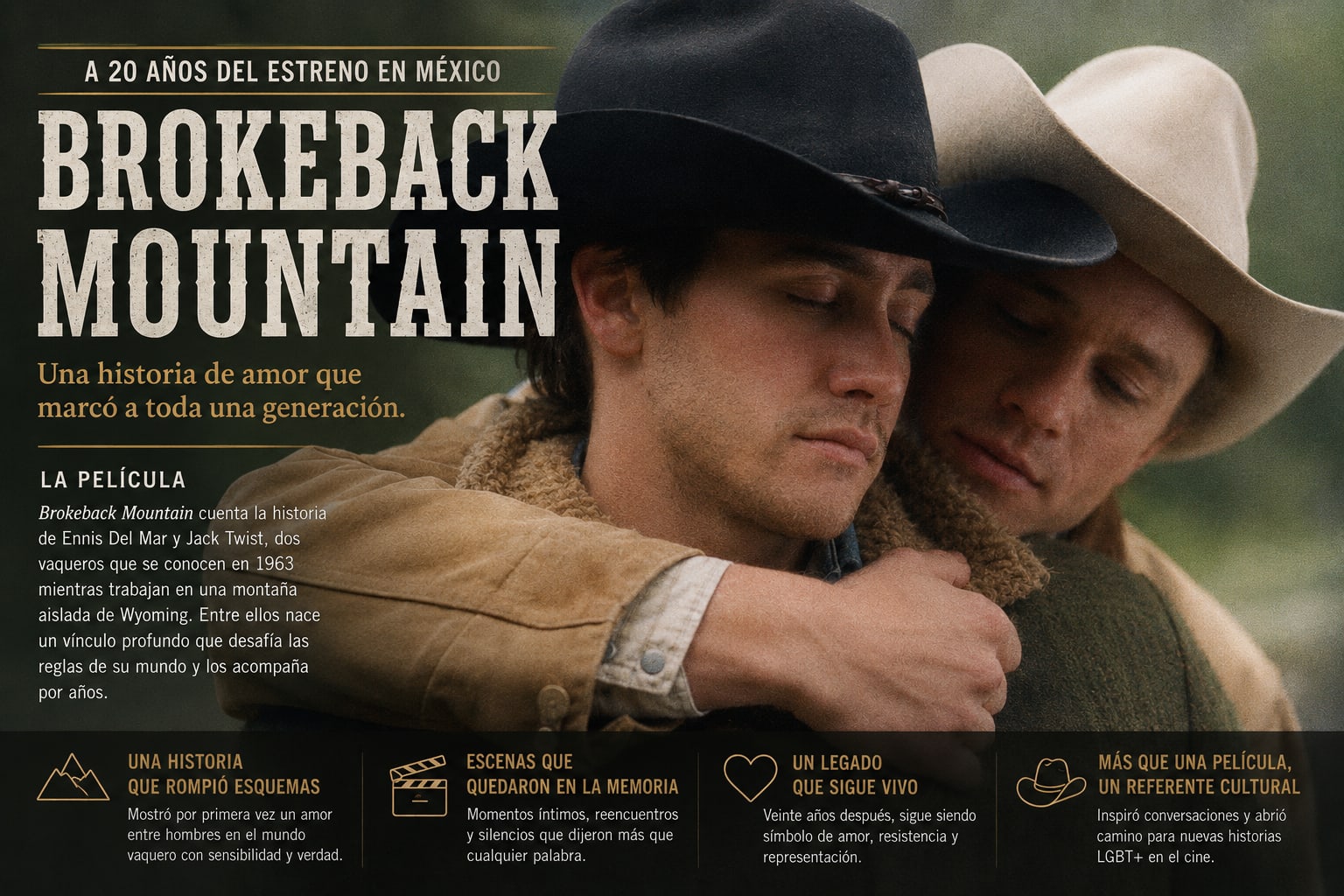
20 Years After Brokeback Mountain: The Film That Changed How Gay Cowboys Are Seen in Cinema
Before discussing what it represented culturally, it is worth explaining why Brokeback Mountain is still considered one of the most important films of the past twenty years.
Because for many young people who never saw it, today it may sound simply like “the gay cowboy movie.” But the reality is that it was much more than that.
A love story marked by silence
The film, directed by Ang Lee, unfolds mainly between the 1960s and 1980s in the western United States.
It all begins when Ennis Del Mar and Jack Twist, played by Heath Ledger and Jake Gyllenhaal, get jobs herding sheep on an isolated mountain called Brokeback Mountain.
Both are young cowboys accustomed to the hard life of the countryside. They speak little, work hard, and come from backgrounds where men do not usually express emotions openly.
Living alone together for weeks on the mountain, among horses, campfires, and long days, they begin to develop an emotional connection that gradually turns into a romantic relationship.
But the problem is never what they feel for each other.
The real conflict is the world they have to return to.
When the work on the mountain ends, both try to continue with the life expected of them: they marry women, start families, and appear normal within conservative communities where a relationship between men would be unacceptable.
However, for years they keep meeting in secret because neither can forget what they experienced together.
And that is where the film hits emotionally.
Because it is not a simple or idealized love story. It is a story about what happens when two people feel something real in an environment where they believe they can never live it freely.
The scenes that made the film historic
Much of Brokeback Mountain's impact came from scenes that are now considered iconic in cinema.
One of the most famous occurs early in the film, when both characters spend a night together for the first time while working on the mountain. The scene was shocking for its time because it showed desire, vulnerability, and emotional confusion between two masculine men within a cowboy context, something almost never seen in Hollywood.
Another much-remembered scene happens when Jack visits Ennis after several years without seeing each other. The reunion makes clear that what they felt never disappeared, even after trying to build “normal” lives.
The final scene also became historic, where one of the characters keeps some old shirts hanging inside a closet as a silent memory of the relationship. It is a simple moment, but extremely painful because it sums up everything they could never live openly.
And perhaps one of the most famous lines from the film is:
“I wish I knew how to quit you.”
Which in Spanish could be understood as:
“Ojalá supiera cómo dejarte.”
The line became emblematic because it perfectly sums up the relationship between the two: a love they could never let go of, even though they did not know how to live it fully.
Why was the film so important?
Today it may seem normal to find LGBT characters in films or series, but in 2005 that was very different, especially within the rural and cowboy world.
Until then, Hollywood showed cowboys as symbols of tough, silent, traditional masculinity. Brokeback Mountain completely broke that idea by presenting two masculine, hardworking, reserved men who also fell in love.
And that impacted enormously people who grew up on ranches, in small towns, or in conservative communities in Mexico and the United States.
Because many rural gay men recognized themselves for the first time in those characters.
Not in caricatures.
Not in urban stereotypes.
But in men who looked like them.
Silence, fear of what people would say, the pressure to marry, double lives, and the feeling of having to hide real emotions were things that a huge number of people understood immediately when they saw the film.
That is why, twenty years later, Brokeback Mountain is still much more than a romantic story.
It is a film that opened conversations that previously seemed impossible within the cowboy and rural imagination.
And for an entire generation, it was also the first time they understood that stories like those had always existed… even if almost no one talked about them.