
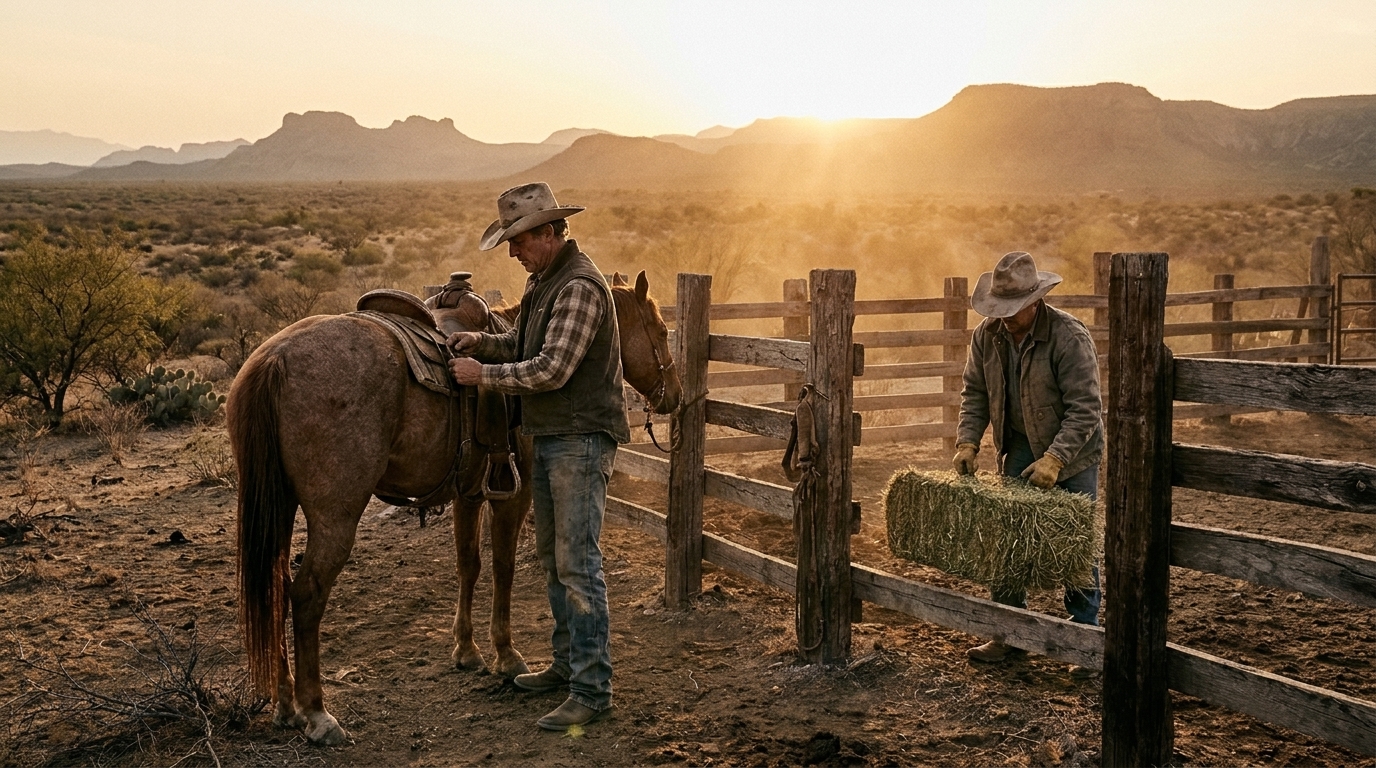
Where Cowboy Culture Comes From: History, Northern Mexico, and Its Mark on Mexican Culture
When someone says "cowboy," the mind usually goes to a movie, a felt hat, and a desert that looks like a studio set. But cowboy culture is much older and much more mixed than its Hollywood version. It was born from working with cattle in arid lands, was assembled with tools from several traditions, and found in northern Mexico one of its most fertile territories.
In this article we review where that culture comes from, how it formed on the border, and how much of what we now call "cowboy" is actually a legacy of the Mexican countryside.
The trade before the character
Before becoming an icon, the cowboy was a worker. Extensive cattle ranching in dry areas forced the development of techniques to move, brand, and care for animals across enormous terrain with little water. That set of skills—riding, roping, healing, reading the weather and the land—is the real core of cowboy culture.
The Iberian Peninsula contributed much of that trade: jineta-style riding, handling fighting bulls, the use of leather, and certain types of saddles and bridles. With the arrival of cattle in the Americas, those practices adapted to a different landscape and a much larger scale.
- The horse stopped being a luxury and became a daily work tool.
- Leather became the material for everything: lasso, reins, chaps, containers.
- Free-roaming cattle required riders capable of covering enormous distances and working as a team.
There is the foundation: a practical trade, passed down from generation to generation, with more technique than romanticism.
Northern Mexico as a laboratory of cowboy culture
In the northern territories—what are now states such as Sonora, Chihuahua, Coahuila, Nuevo León, Durango, and Zacatecas—cattle ranching found harsh conditions and room to grow. There a work system was consolidated that was later recognized as cowboy throughout the continent.
From that region came words that are now used throughout the ranching world, even in English: buckaroo, for example, is a corruption of "vaquero." Techniques for handling cattle, ways of braiding leather, and ways of organizing work by crews also came from there.
The north was not an isolated place. It was a strip of permanent contact: families who crossed, workers who moved following the cattle, markets and fairs where animals, tools, and songs were exchanged. Cowboy culture did not respect border lines because the border came later.
What is shared and what is confused
Much of the aesthetic that the world associates with "cowboy" has Mexican roots: the wide-brimmed hat for the sun, leather chaps, the horned saddle, the lasso. What changed was the name and the narrative. The ranch culture of northern Mexico and that of the southwestern United States are close relatives, not copies of each other.
Ranch life: more than an aesthetic
Cowboy culture is sustained by concrete routines. The workday starts early, is organized around water and pasture, and depends on cooperation. There are chores that bring together entire neighbors, such as branding or gathering cattle, and there is a fairly clear work ethic: deliver, don't show off, help.
- Seasonal work: droughts, rains, and breeding cycles mark the calendar.
- Knowledge of the land: knowing where there is water, which road floods, which animal gets sick first.
- Constant repair: tools, fences, stables. Almost everything is fixed before it is replaced.
- Hospitality: on the ranch, welcoming those who arrive is not courtesy, it is the norm.
That life also has a strong social dimension: shared food, music at the end of the day, long conversation in the shade. That is where cowboy culture stops being a trade and becomes identity.
Music, clothing, and language: the mark on Mexican culture
Cowboy influence is at the center of Mexican popular culture. Regional music from the north—with its different variants—was born from that world: it speaks of horses, roads, absences, and loyalties. Instruments such as the accordion and the bajo sexto were integrated into a repertoire that already came from the countryside.
Clothing also tells the story. Work boots, the hat, the long-sleeved shirt, the belt with a buckle: garments that were first protection and later became symbols. Today they are worn in the city, at parties, and on the runway, even though their origin is purely practical.
And language: northern speech is full of ranch words. Expressions about horses, lassos, and corrals are used to talk about people, politics, and love. Cowboy culture is not only seen: it is heard.
From the ranch to the screen and back
Film and television popularized a stylized version of the cowboy, often without a Mexican face. That narrative left out a good part of those who sustained the trade. That is why today it makes sense to return to the sources: to the cattle families of the north, to the chores, to the songs that were actually born there.
A living culture, also for the LGBT+ community
There is a mistaken idea that the ranch world is homogeneous and closed. The reality is more interesting: in towns and at fairs there is diversity, although it is not always named out loud. Many people have grown up among horses and cattle, with affections that did not fit the traditional cowboy script.
Recognizing that presence is not rewriting history, it is completing it. Cowboy culture has always belonged to people who work, help each other, and share the little there is. That ethic leaves room for many ways of being a man, being a woman, and being a family on the ranch.
If the history of the cowboy teaches anything, it is that traditions are not museum pieces: they adapt, mix, and continue to serve as long as someone practices them. The hat changes owners, the trade is learned anew, and the culture keeps moving.
Do you have a ranch, fair, or cowboy family story you want to share? Write to us: the best articles in this section are born from what the community tells us.