
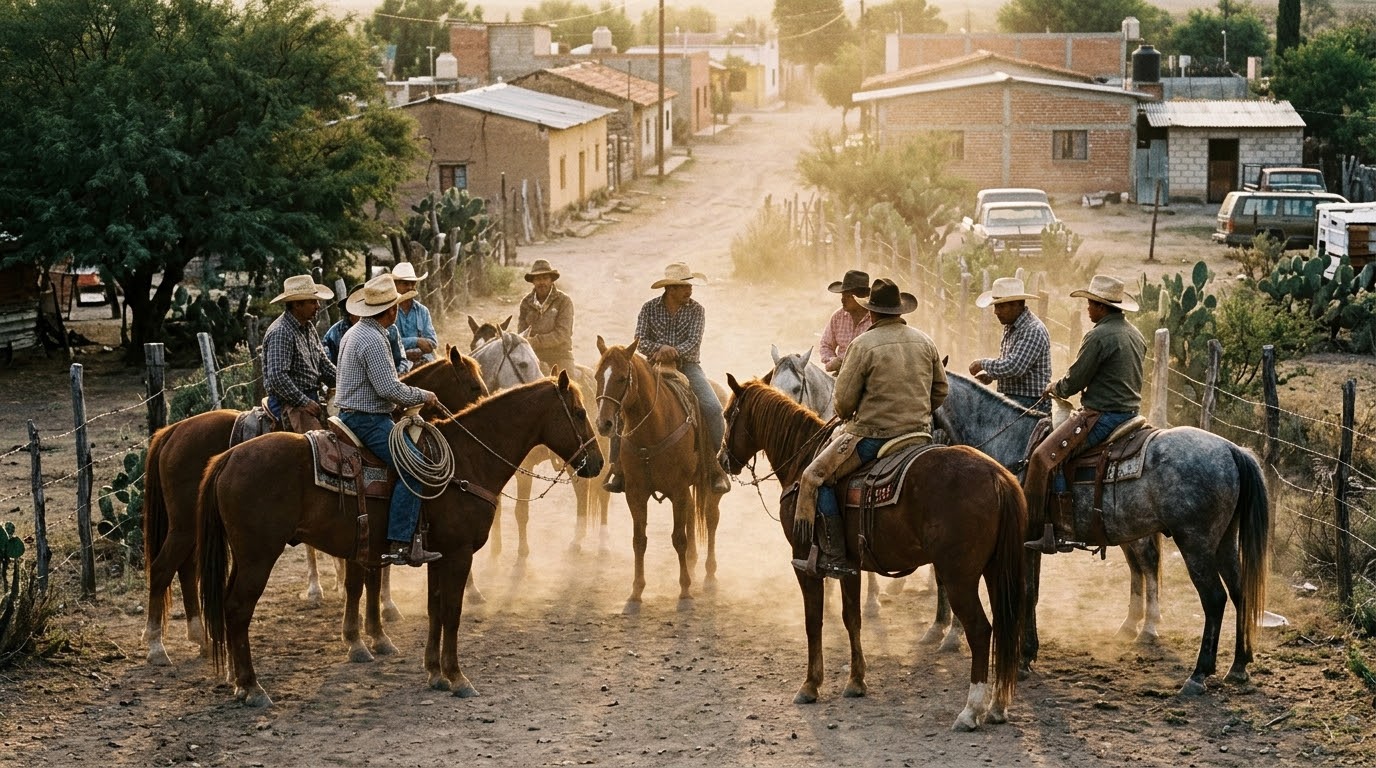
What does it mean to be a vaquero in present-day Mexico?
For a long time, the word vaquero was almost automatically associated with a specific scene: a man on horseback, dust on his face, a ranch in the north of the country, and a workday that begins before dawn. That image exists and remains valid, but it is no longer enough to explain everything the vaquero identity means in Mexico today.
In recent decades, that identity has shifted. It moved to the cities, blended with other aesthetics, found new audiences and also new questions. Today there are those who make a living from cattle ranching and recognize themselves as vaqueros, and there are those who work in an office Monday through Friday and on Saturday put on their boots to go to a cabalgata. Both speak of the same thing, even if they do so from different places.
This text does not seek to define a single correct version of what it means to be a vaquero. It seeks to understand what is preserved, what has changed, and why that identity still holds so much force in a country that urbanized quickly.
From cattle work to cultural belonging
Vaquero culture in Mexico was born from work. Cattle handling techniques, the use of the horse, the design of the saddle, and the way a cattle drive is organized have practical roots: they were responses to concrete needs of the countryside. Over time, those tools also became language, symbol, and family heritage.
That transition is key to understanding the present. When a work practice becomes a tradition, it no longer depends on your practicing it daily to continue making sense. The same happens with clothing: boots and hats were created to protect against the sun, dust, and brush, and today they are also worn at a wedding, at a concert, or on a Sunday afternoon.
That is why it is worth separating two things that are sometimes confused:
- Being a vaquero by trade: someone who works with cattle, on a ranch, or in activities related to the countryside.
- Being a vaquero by cultural affinity: someone who identifies with the traditions, aesthetics, music, and ways of socializing that surround that world.
Neither is more authentic than the other. The first sustains the practice; the second sustains cultural continuity. Without generational succession in the countryside, the tradition weakens; without people who admire it and practice it in other spaces, it fades.
Clothing: boots, hats, and what they say about you
Few things communicate so much with so little as vaquero attire. A wide-brimmed hat, leather boots, a work shirt, and a belt with a buckle form an instantly recognizable ensemble, even for someone who has never been near a corral.
But clothing is not uniform. It changes according to region, climate, occasion, and budget. A felt hat is not worn the same way in a humid climate as in a dry one; work boots have different soles and reinforcements than dress boots; some prefer the classic cut and others incorporate more contemporary details.
There are also unwritten codes. In many vaquero circles, clothing speaks of experience, respect for the occasion, and knowledge of the environment. A well-cared-for hat, clean boots, and a proper fit communicate more than an expensive piece. And there is something that bears repeating: clothing is worn, not displayed. It is used, repaired, inherited.
In the cities, that same attire coexists with denim jeans, T-shirts, and sneakers. The mix is no longer perceived as a contradiction. It is a way of saying "this is also me" without having to give up the rest.
Music, rodeos, and cabalgatas: where identity becomes visible
If clothing is the everyday language, the celebration is the moment when that language becomes collective. Regional Mexican music—with its different variants and generations—has been one of the most powerful vehicles of this culture. Its lyrics speak of horses, roads, loyalties, and farewells, and its audience renews with each decade.
Rodeos and cabalgatas serve a similar function. They are spaces where skill becomes spectacle, but also where people who share an origin or a passion meet again. In a cabalgata, you are not only moving along a path: a belonging is confirmed. People greet one another, converse, and recognize the one who knows how to ride and the one who is learning.
It must be said without romanticism: these spaces also have hierarchies, rules, and tensions. They are not always welcoming to those who come from outside, and women have had to make a place for themselves in activities that for a long time were thought to be only for men. Acknowledging this does not diminish the tradition; it makes it more honest and more livable.
An urban Mexico that is also vaquero
The majority of the Mexican population lives in cities, and that has not eliminated vaquero culture: it has rearranged it. In metropolitan areas, boot and hat shops, fairs, palenques, dances, and groups that organize to go out to the countryside on weekends proliferate.
The way of learning has also changed. Someone who did not grow up on a ranch can approach it through other paths: a relative, a friend, a club, a riding school, or simply curiosity. That learning is slower and less formal, but it exists and is real.
The result is a more porous identity. One can be a vaquero and study for a university degree, work in a city and return to the town on vacation, listen to regional music and also other genres. Identity stopped being a closed package and became a mix that each person manages in their own way.
Being a vaquero today: an identity that is chosen and cared for
In present-day Mexico, being a vaquero implies, above all, a decision. It implies recognizing oneself in a history, adopting certain ways of dressing and socializing, respecting codes, and, often, learning from someone else. It does not require one's own ranch or a ranching surname. It requires interest, respect, and a willingness to understand where all of this comes from.
That openness also extends to the LGBT community, which has found in vaquero culture a space for expression and gathering. It is not about inventing a new tradition, but about inhabiting it without having to hide a part of oneself. The aesthetics of the countryside, the music, and the celebration allow for many ways of living it.
At the same time, it is worth avoiding two extremes. One is idealization: thinking that the countryside is a pure place without conflicts. The other is caricature: reducing what is vaquero to a costume or a party character. Identity holds up better when its origin is known, when those who practice it daily are respected, and when it is accepted that it is changing.
Perhaps the most honest answer to the question in the title is this: being a vaquero in today's Mexico means carrying an inheritance and deciding what to do with it. Some work it every day in the countryside. Others wear it on the weekend. Many pass it on to their children, their friends, or anyone who approaches with genuine curiosity. In all those cases, the tradition stays alive, and that is what really matters.